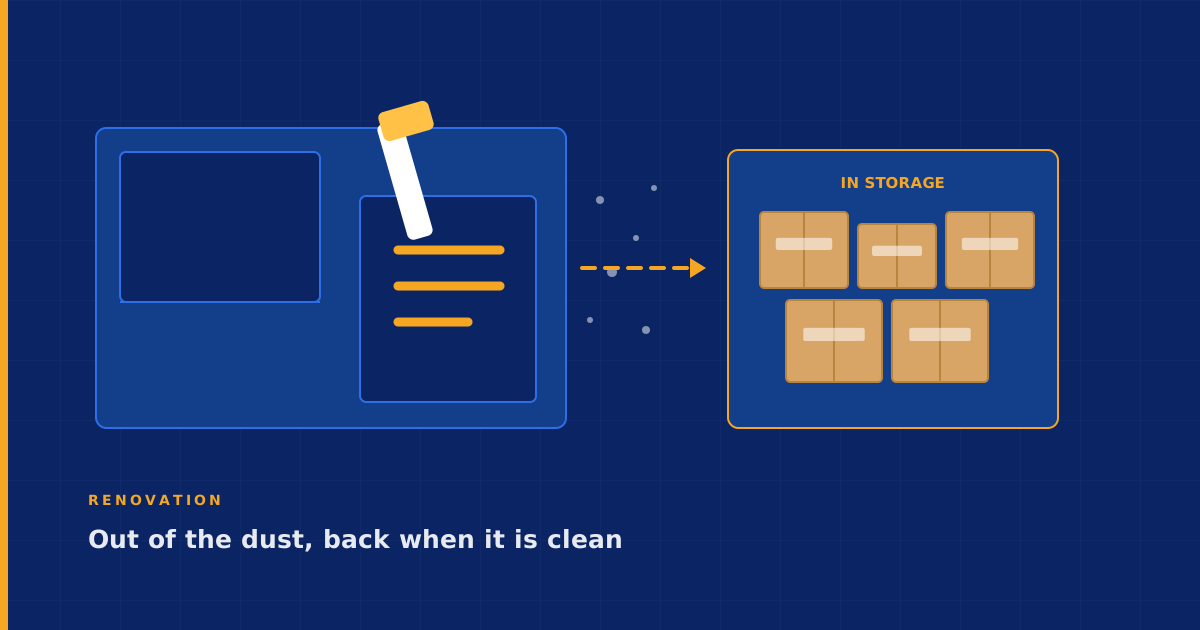
Why leaving furniture in situ does not work
The plan is always the same: push everything into the middle of the room, throw dust sheets over it, and let the contractor work around it.
The problem is what renovation dust actually is. Sanding gypsum, cutting tile, chasing walls for conduit and demolishing block all produce a very fine particulate that behaves more like smoke than like sand. It travels through the whole flat, it goes around dust sheets rather than being stopped by them, and it settles into anything with a fibre or a gap: upholstery, mattress seams, curtain fabric, speaker grilles, keyboard, the runners of a drawer.
Upholstery and mattresses that have taken construction dust do not fully recover from vacuuming. That is the real cost, and it usually exceeds the storage bill.
The second reason: an empty room is a faster room
This one is easier to measure. Trades work faster in an empty space.
A painter cutting in around a wardrobe is slower than one painting a flat wall. A tiler working half a room at a time, then shifting furniture and doing the other half, has two set-ups instead of one. And on almost every job there is an hour at the start of the day where somebody moves furniture from one wall to the other.
On a six-to-ten week apartment renovation, clearing the space typically takes days off the programme. If you are paying rent on the flat while it is being renovated, those days are money.
What to move out, and what to leave
Move out:
- All upholstered furniture — sofas, armchairs, headboards, dining chairs
- Mattresses and bedding, without exception
- Curtains and rugs
- Electronics, including anything with a fan or a vent
- Free-standing wardrobes, dressers and bookcases
- Artwork, mirrors and anything framed
- Clothes, which take smoke-like dust and hold it
Leave, usually:
- Built-in wardrobes and fitted kitchen units — they are not yours to move and they are part of the works
- White goods, if the kitchen is not being touched, sealed with plastic
- Anything the contractor needs, such as a ladder or a work table
Sequencing it around the contractor
The order that works:
- Fix the contractor's start date first. Storage is scheduled around the renovation, not the other way around.
- Collect one or two days before the trades arrive. Not the same morning — two crews in one flat is how things get damaged and how both jobs run late.
- Store for the duration. An apartment renovation is typically six to twelve weeks. A villa is longer.
- Do not book the return against the contractor's finish date. Book it against the finish date plus the cleaning, plus paint curing time. Freshly painted walls need days, not hours, before furniture goes back against them.
Assume the programme slips
Renovations overrun. Materials arrive late, an approval takes longer than expected, and something behind a wall turns out not to be where the drawing said it was.
This is the practical argument for storage with no lock-in and no fixed term. If your storage arrangement penalises you for extending, a three-week contractor delay becomes a three-week financial problem as well as a scheduling one. With Smart Space there is no lock-in contract — if the programme slips, the storage simply continues at the monthly rate.
Equally, do not pre-book the return delivery for a date you are not confident in. Confirm the return once the site is genuinely clean. Collection and return timing is confirmed based on availability, so give as much notice as you can once you know.
What it costs
Two charges. Storage is monthly — AED 500 for boxes only, AED 700 for a studio, AED 1,200 for a one-bedroom, AED 1,950 for a two-bedroom and AED 2,600 for a villa. Packing and transport is a separate one-off charge, from AED 850 to AED 5,000 depending on size. All prices exclude 5% VAT.
Return delivery is quoted separately and charged in addition, unless it is included in your agreed package.
If the renovation is essentially a repaint, it is usually cheaper to have the same people handle both — painting booked together with storage saves AED 200. See move, store and paint.
Want this priced for your place?
Send a few photos of the rooms on WhatsApp. We come back with the size, the cost and a collection slot — before you commit to anything. Storage from AED 500 a month, excluding VAT, with no lock-in contract.
Get a quote on WhatsAppOr read more about Storage during renovation.